How Much Does It Cost to Climb K2? 2027 Price Breakdown

By Riaz Ahmed Shigri, Logistics and Marketing Manager, Chogori Adventure, Skardu · Updated November 2026
How much does it cost to climb K2?
With Chogori Adventure, climbing K2 costs $12,000 per person on Base Camp Only or $26,000 per person on Full Board, for a 50-day expedition from Islamabad back to Islamabad (2027 season). The K2 royalty, the climbing permit, the national park fee and the liaison officer are included in both packages. Your own costs on top are international flights, the Pakistan visa, insurance that covers helicopter rescue, your personal gear, the summit bonus and staff tips.
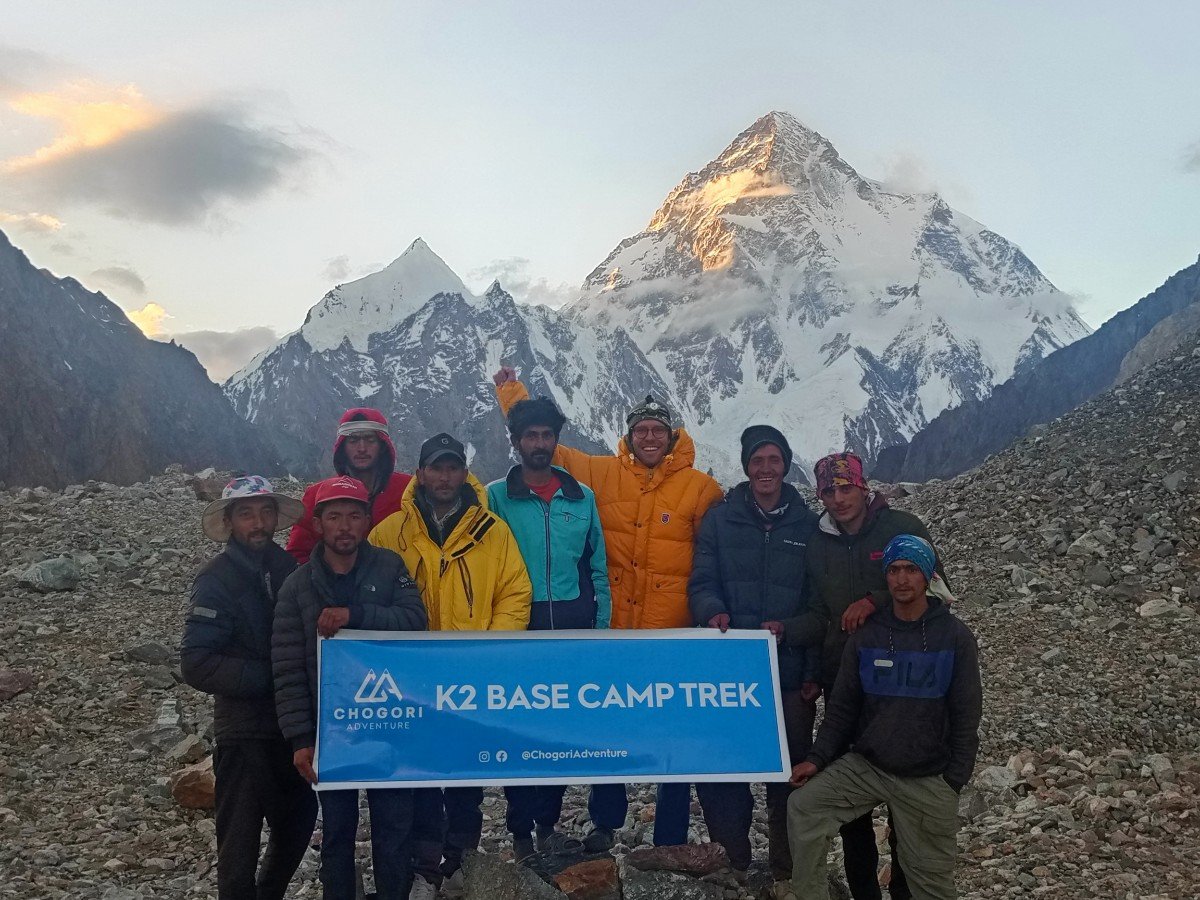
Below, every cost is explained line by line, with our own prices. To see the dates and book, go to the K2 Climbing Expedition page. Only want to trek to the foot of K2? That is a different trip: see the K2 Base Camp Trek cost ($2,300 per person).
This guide is about money: what you pay, what it buys, and what you still need to budget for. It also explains why a K2 expedition costs what it does, gives worked examples for different kinds of climbers, and sets out how payment and cancellation work. For the route, the camps and the climbing itself, read our K2 climbing guide.
K2 climbing cost at a glance
| Base Camp Only | Full Board | |
|---|---|---|
| Price per person (fixed departure) | $12,000 | $26,000 |
| K2 royalty, climbing permit, national park fee | Included | Included |
| Liaison officer, garbage and environment fee | Included | Included |
| Hotels, flights Islamabad–Skardu, jeep to Askoli | Included | Included |
| Porters, meals and our base camp | Included | Included |
| Pakistani high-altitude porters (HAPs) | Not included | 1 for every 2 climbers |
| Rope fixing, high-camp tents, gas and stoves | Not included | Included |
| Oxygen | Not included | 2 bottles per climber, with mask and regulator |
| Length | 50 days | 50 days |
Base Camp Only covers all our services up to and at base camp, and nothing above it. Full Board adds our climbing support above base camp. Groups are 3 to 10 climbers on both packages. Our 2027 fixed departure runs from 20 June to 8 August and is confirmed.
Why climbing K2 costs what it costs
A K2 expedition costs thousands of dollars because it is 50 days of transport, permits, staff and food in one of the most remote places on Earth, plus the climbing support above base camp. The royalty is only USD 3,500 of the price. Most of the money goes on people, loads and time.
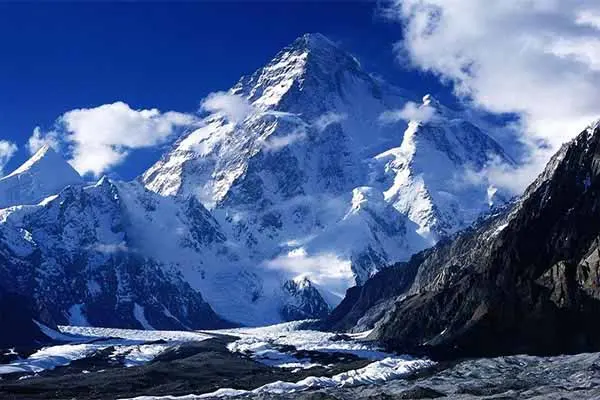
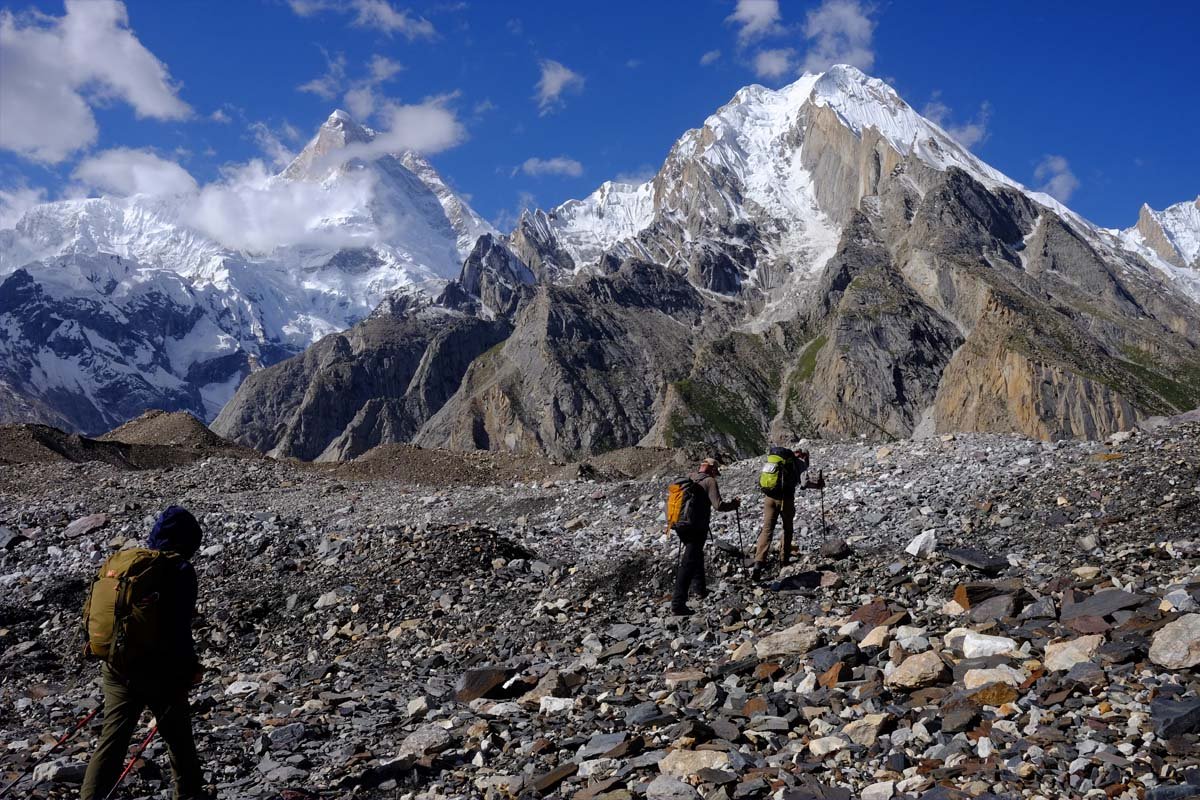
K2 (8,611 m, 28,251 ft) stands at the head of the Baltoro Glacier, on the border of Pakistan and China. There is no road to the mountain and no village near it. The last road ends at Askoli (3,000 m). From there, everything the expedition needs for about five weeks is carried by porters for eight days, up the Braldu valley and the Baltoro Glacier, about 63 km long, to K2 Base Camp at about 5,150 m. That includes the food, the kitchen, the fuel, the tents, the ropes and the oxygen. When the expedition ends, the porters come back up to carry the camp and the rubbish out again.
Here is where the money in a K2 package goes, in plain terms:
- Government fees: the royalty, the climbing permit, the Central Karakoram National Park fee, and the garbage and environment fee.
- The liaison officer: every K2 expedition must take a government liaison officer. The expedition pays for the officer’s equipment, fees and allowances.
- Transport: return flights between Islamabad and Skardu (or two days by road each way if the flight is cancelled), and jeeps between Skardu and Askoli, a drive of 5 to 7 hours each way.
- Hotels: 6 hotel nights on the way in and out, 3 in Islamabad and 3 in Skardu.
- Porters: wages, food and insurance for the porters who carry all the expedition supplies to base camp, and back again.
- The base camp: about four weeks at about 5,150 m with a cook, a kitchen team, a dining tent, personal tents, a toilet, showers, solar power, a generator, radios, a satellite phone and a medical kit with a portable altitude chamber.
- Climbing support (Full Board only): Pakistani high-altitude porters, a rope-fixing team, ropes, high-camp tents, gas, stoves, high-altitude food and oxygen.
Time is the hidden driver. A 50-day trip means 50 days of staff wages and 50 days of food, whether or not the weather lets anyone climb. On Full Board, $26,000 is about $520 a day; on Base Camp Only, $12,000 is about $240 a day. Those daily figures cover every service in the package, from the airport pick-up to the last hotel night.
What the price includes
Both packages
- Hotels: 1 night in Islamabad on arrival and 2 on return, 2 nights in Skardu on arrival and 1 on return, twin sharing; bed and breakfast in Islamabad, all meals in Skardu
- Islamabad–Skardu return flights (by road if the flight is cancelled) and the jeep to Askoli and back
- The K2 royalty, climbing permit, national park fee, and the garbage and environment fee
- The liaison officer’s equipment, fees and allowances
- A visa sponsor letter, and the briefing and debriefing with the Gilgit-Baltistan Tourism Department
- All meals on the trek and at base camp, an experienced Pakistani cook and kitchen team
- Porters to carry all expedition supplies to base camp, and a personal baggage allowance of 65 kg (110 lb)
- A personal tent for each climber at base camp, a dining tent, toilet, showers and hot water
- Solar power and a backup generator, walkie-talkie radios, a satellite phone (fixed call charges), regular weather reports and Wi-Fi at base camp (not always reliable)
- A medical kit, pulse oximeter and a portable altitude chamber (Gamow bag) at base camp
- Insurance for our guide, cook, kitchen staff, assistants and porters
Full Board adds
- One Pakistani high-altitude porter for every two climbers
- A local rope-fixing team, with ropes and fixing gear
- High-camp tents, gas and stoves
- Meals, high-altitude food and snacks above base camp
- Oxygen: 2 bottles per climber and 2 for each high-altitude porter, with a mask and regulator for each climber
The full list, service by service, is in the comparison table on the K2 Climbing Expedition page.
Base Camp Only or Full Board: which one fits you?
Choose Base Camp Only ($12,000) if you or your team will handle everything above base camp yourselves; choose Full Board ($26,000) if you want our rope-fixing team, high-altitude porters, high camps and oxygen. The $14,000 difference pays for the climbing support on the mountain itself.
Who Base Camp Only is for
Base Camp Only suits climbers who already have a lot of 8,000 m experience and bring their own plan above base camp. Typical cases are a strong team that climbs together and carries its own loads, climbers who come with their own Nepali or Pakistani climbing staff, and climbers who plan to go without oxygen and want to keep the cost down. You still get the full approach, the permits, the liaison officer and a complete base camp with food and a kitchen team for the whole stay. You must then arrange your own high-camp tents, stoves, gas, food above base camp and rope access. You can add a high-altitude porter (USD 4,000), oxygen bottles (USD 700 each) and a mask and regulator (USD 2,000) from us.
Who Full Board is for
Full Board suits most climbers who join a fixed departure. It adds one Pakistani high-altitude porter for every two climbers, a local rope-fixing team with the ropes and fixing gear, the high-camp tents, gas and stoves, the food above base camp, and 2 bottles of oxygen per climber with a mask and regulator. In practice it means you climb with your own personal gear, while the team builds and stocks the camps on the Abruzzi Spur, from Camp 1 at about 6,050 m to Camp 4 on the Shoulder at about 7,800 m.
A quick way to decide
- If you have never set up your own high camps on an 8,000 m peak, choose Full Board.
- If you plan to use oxygen, compare both: on Base Camp Only, a mask and regulator plus 2 bottles costs USD 3,400 alone, before porters, tents and ropes.
- If you are part of a team that brings its own climbing staff, Base Camp Only avoids paying twice for the same support.
Every cost, line by line
| Cost | Base Camp Only | Full Board |
|---|---|---|
| Package price | $12,000 | $26,000 |
| K2 royalty (USD 3,500 per person in summer) | Included | Included |
| Climbing permit, park, garbage and environment fees | Included | Included |
| Liaison officer | Included | Included |
| High-altitude porter | Extra HAP: USD 4,000 each, on request | 1 per 2 climbers included; extra HAP USD 4,000 |
| Oxygen bottles | USD 700 a bottle, on request | 2 included; extra bottles USD 700 each |
| Oxygen mask and regulator | USD 2,000, on request | Included |
| Nepali Sherpas or a Nepali climbing leader | On request, extra cost | On request, extra cost |
| Summit bonus | At least USD 1,000 per climber | At least USD 1,000 per climber |
| Staff tips | At least USD 300 per climber | At least USD 300 per climber |
| Insurance with helicopter rescue and evacuation | Your cost (mandatory) | Your cost (mandatory) |
| International flights to Islamabad and the Pakistan visa | Your cost | Your cost |
| Personal climbing equipment and down suit | Your cost | Your cost |
| Lunch and dinner in Islamabad | Your cost | Your cost |
Worked examples: what you pay us
In these examples, a Full Board climber pays us $27,300 to $32,700 and a Base Camp Only climber $13,300 to $22,100, depending on the oxygen and porters they add. These examples use only our prices and the minimum summit bonus and tips. Your flights, visa, insurance and gear come on top, and you price those yourself.
| Example | What is added | Total paid to us |
|---|---|---|
| Full Board, standard | 2 bottles included; summit bonus USD 1,000; tips USD 300 | $27,300 |
| Full Board, more oxygen | 2 extra bottles (USD 1,400); bonus and tips (USD 1,300) | $28,700 |
| Full Board, own HAP | An extra HAP (USD 4,000); 2 extra bottles (USD 1,400); bonus and tips (USD 1,300) | $32,700 |
| Base Camp Only, no oxygen | Bonus and tips (USD 1,300) | $13,300 |
| Base Camp Only, with oxygen and a HAP | Mask and regulator (USD 2,000); 4 bottles (USD 2,800); a HAP (USD 4,000); bonus and tips (USD 1,300) | $22,100 |
| Base Camp Only, private pair | Private price for 2 people ($14,000 each), a HAP each (USD 4,000), bonus and tips (USD 1,300) | $19,300 each |
The fifth example shows why Full Board is often better value. A Base Camp Only climber who buys oxygen, a mask and a personal porter pays us $20,800 before the bonus and tips, but still has to provide the high-camp tents, stoves, gas, ropes and food above base camp. Full Board includes all of that, plus the rope-fixing team, for $26,000. The private pair example shows the other side: a strong pair with their own high-altitude porters can keep the cost well below Full Board, as long as they can handle the camps.
The K2 royalty in 2027
The K2 royalty is the government fee for climbing the mountain. It is currently USD 3,500 per person in summer, the rate set by the Gilgit-Baltistan government in May 2025, and it is charged per climber, not per team. It is included in both of our packages, so you don’t pay it separately.
You may still see older figures online, such as USD 5,000 per person or group permits for seven climbers. Those rates no longer apply. If the government changes the royalty, we will update our prices and this page.
How the permit works
For every visa type, the documents, the permits and a table of which places need which visa, see our Pakistan visa guide.
We apply for your K2 climbing permit through the Gilgit-Baltistan Tourism Department. For the application we need a copy of your passport, a passport photo and your climbing CV, which lists the peaks you have climbed. Send these as early as you can, because the permit takes several weeks. Once the permit is under way, we send you a sponsor letter for your Pakistan mountaineering visa, which you apply for online at visa.nadra.gov.pk.
In Skardu, before the trek starts, our office completes the government formalities, and you attend the official briefing with the Gilgit-Baltistan Tourism Department. After the expedition, there is a debriefing. Both are included in the price.
The liaison officer
The liaison officer is a government-appointed officer who goes with the expedition to base camp and acts as the link between the team and the authorities. Under the rules for 8,000 m peaks, the expedition provides the officer’s equipment, fees and allowances. In our packages, this is all included, so it does not appear as a separate bill.
Oxygen and high-altitude porters
These are the two biggest choices that change your cost on K2.
- Oxygen: Full Board includes 2 bottles for each climber and 2 for each high-altitude porter, with a mask and regulator for each climber. Extra bottles cost USD 700 each. On Base Camp Only you can buy bottles at the same price, and a mask and regulator for USD 2,000. When to start using oxygen is decided on the mountain by the guides and the climbers.
- High-altitude porters (HAPs): Full Board includes one Pakistani HAP for every two climbers. An extra HAP costs USD 4,000, so you can have one of your own. Extra Nepali Sherpas or a Nepali high-altitude climbing leader are available on request, at extra cost.
How many oxygen bottles do you need?
Oxygen on K2 is mainly used high on the mountain, at the top camps and on summit day, which starts from Camp 4 on the Shoulder at about 7,800 m and climbs through the Bottleneck at about 8,200 m. The 2 bottles in Full Board are for that push. Climbers who want a higher flow rate, an earlier start on oxygen, or a reserve for a second summit attempt buy extra bottles at USD 700 each. Bottles have to be carried up the mountain, so tell us before the expedition how many you want; we then plan the loads with the high-altitude porters.
Some climbers go to the summit without oxygen. That needs a lot of experience on other 8,000 m peaks without oxygen, and it is much harder and riskier. Even then, we recommend having oxygen on the mountain for an emergency.
What a high-altitude porter does
A high-altitude porter carries loads between the camps, helps set up the high camps, and climbs with you on the fixed ropes. On Full Board, one HAP supports two climbers. An extra HAP at USD 4,000 gives you a porter of your own, which means more help with loads and a dedicated partner on summit day. If you prefer to climb with Nepali Sherpas or a Nepali climbing leader, we can arrange them on request, at extra cost.
Your own costs
These are not in either package, and you pay them yourself:
- Insurance: mountaineering insurance that covers helicopter rescue and evacuation is mandatory. If a helicopter rescue is needed, your insurance pays for it. Global Rescue is one option, and any insurer is fine if it provides helicopter rescue and evacuation and good cover at altitude on K2 (8,611 m).
- Flights and visa: your return flights to Islamabad and the Pakistan visa. You apply for the mountaineering visa online at visa.nadra.gov.pk, with the sponsor letter we send you. The fee depends on your nationality.
- Personal gear: your climbing equipment, 8,000 m boots and down suit. Bring your own gear; rental in Skardu is limited. Our K2 packing list (PDF) lists everything.
- Summit bonus and tips: a summit bonus of at least USD 1,000 per climber and staff tips of at least USD 300 per climber.
- Meals in Islamabad: lunch and dinner in Islamabad (breakfast is included at the hotel).
What your insurance must cover
Your policy must name mountaineering and cover the full height of the climb, 8,611 m, not only trekking. Check these points before you buy it:
- Helicopter rescue and evacuation in northern Pakistan, from base camp and from the mountain
- Emergency medical treatment and repatriation
- Trip cancellation and interruption, so that you are covered if you must leave early or cannot travel
- The whole 50 days, from your arrival in Islamabad to your flight home
Our terms and conditions make insurance mandatory for every participant, and we may ask for proof before departure.
Personal gear to budget for
Gear is the cost that varies most from climber to climber, because many people already own most of it. For K2 you need an 8,000 m down suit, double or triple high-altitude boots, a down sleeping bag for very low temperatures, a harness, a jumar (ascender), a descender, crampons, an ice axe, a helmet, down mittens and goggles. Bring your own energy bars and gels, because they are not available in Pakistan. Above base camp on Full Board, the food is provided, but many climbers like their own snacks for summit day. The packing list above covers every item.
Hidden costs to plan for
- Returning early: if you, or your whole group, decide to leave the expedition early, for any reason, the extra costs are not included and not covered by us: for example extra hotel nights, extra jeeps or other transport, changed flights, or a guide or porter to take you back.
- Helicopter rescue: rescue costs are not in the price; your insurance pays them. Check that your policy covers helicopter evacuation on K2 before you book.
- Extra oxygen or support: if you decide on the mountain that you want more oxygen or another HAP, the prices above apply.
- Excess baggage: your personal allowance on the expedition is 65 kg (110 lb). Your airline’s baggage rules for the flight to Islamabad are separate.
- Bank and currency fees: transfer fees and currency conversion charges are paid by the client, so allow for them when you send the deposit and the balance.
- Satellite calls: the satellite phone at base camp is included, but calls are charged at a fixed rate.
Private expedition prices
For your own team and dates, the price per person depends on the size of your group:
Base Camp Only, private group
| Solo | 2 to 3 people | 4 to 6 people | 7 to 10 people |
|---|---|---|---|
| $18,000 | $14,000 | $12,000 | $10,000 |
Full Board, private group
| Solo | 2 to 3 people | 4 to 6 people | 7 to 10 people |
|---|---|---|---|
| $30,000 | $28,000 | $26,000 | $23,000 |
A private group of 7 to 10 pays less per person than a fixed departure, and a solo climber pays the most. The reason is that much of an expedition’s cost is shared: the liaison officer, the cook and kitchen team, the base camp, the dining tent and the rope-fixing team cost about the same for one climber as for eight. Split across a larger team, each person pays less. The royalty, on the other hand, is per person, so it is the same in every column.
For example, a team of 8 on Full Board pays $23,000 each, or $184,000 for the team. A solo climber on Full Board pays $30,000 for the same services on their own dates. If you are a group of 2 or 3 and flexible on dates, joining our fixed departure at $26,000 on Full Board or $12,000 on Base Camp Only is usually cheaper than a private expedition.
How long does it take to climb K2?
Our K2 expedition takes 50 days from Islamabad back to Islamabad, with 23 climbing days on the Abruzzi Spur and a spare day for the weather. The length is one of the main reasons for the cost: everything in the package runs for the full 50 days.
| Days | What happens | Where you sleep |
|---|---|---|
| 1–4 | Arrival, briefing, flight to Skardu (2,230 m), permits and final shopping | Hotels in Islamabad and Skardu |
| 5–13 | Jeep to Askoli (3,000 m), then the trek via Jhola (3,200 m), Paiju (3,400 m, with a rest day), Khoburtse (3,800 m), Urdukas (4,000 m), Goro II (4,300 m) and Concordia (4,691 m) to K2 Base Camp (about 5,150 m) | Tents |
| 14–15 | Rest, medical checks and planning the rope fixing | K2 Base Camp |
| 16–38 | Climbing period: load carries, acclimatisation rotations, rope fixing and the summit attempt in a weather window | Base camp and high camps |
| 39 | Spare day for a delayed summit, a second window or the descent | K2 Base Camp |
| 40–45 | Walk out to Askoli | Tents, then a camp or guesthouse in Askoli |
| 46–50 | Jeep to Skardu, rest day, flight to Islamabad, debriefing and departure | Hotels in Skardu and Islamabad |
The climb itself cannot be rushed. Climbers need several rotations up and down between base camp and the high camps to adapt to the altitude, and the team needs time to fix ropes through House’s Chimney and the Black Pyramid up to the Shoulder. The number and timing of summit days depend on the ground staff, the conditions on the mountain and the weather. Our K2 climbing guide explains each section of the route.
Climbing K2 outside the summer season
The best time to climb K2 is from 20 June to 8 August, and our fixed departures start on 20 June. We also run private K2 expeditions in other seasons, at the same price.
The summer window is when the weather on the Baltoro is most settled and most teams are on the mountain. Outside it, the days are colder and the weather windows are fewer and shorter, so a private expedition in another season needs more experience and more flexibility. Our price does not change with the season: a private Full Board expedition for a solo climber costs $30,000 in June or in any other month, and a team of 4 to 6 pays $26,000 each.
Is K2 harder than Everest, and why is the cost different?
K2 is widely considered more technically demanding than Everest, with a higher fatality rate and less margin for error, even though it is lower: 8,611 m against 8,849 m. The climbing is steeper for longer, the weather is harder to predict, and summit day passes the Bottleneck, a steep couloir below a large serac at about 8,200 m.
The costs differ for different reasons. We run expeditions in Pakistan only and do not quote other companies’ prices, but the government fee shows the main gap: Nepal charges a much higher permit fee for Everest than Pakistan’s K2 royalty of USD 3,500 per person. K2 also has a long approach on foot: everything is carried for eight days from Askoli to base camp.
For a climber, the more useful question is not which mountain is cheaper but which one you are ready for. You need at least one 7,000 m peak before K2, and many climbers first climb another 8,000 m peak. Our page on 8,000 m peaks by difficulty compares the options in Pakistan.
How to keep the cost down
- Join a fixed departure or bring a group: a private team of 7 to 10 pays the lowest price per person.
- Choose Base Camp Only if you have your own climbing support above base camp, and add only the HAPs or oxygen you need.
- Bring your own gear from home rather than renting in Skardu.
- Prepare on a 7,000 m peak first: you need at least one 7,000 m peak before K2, and good preparation is the best way not to waste your expedition. Our Spantik Expedition (7,027 m, 28 days, $6,050) is one way to get that experience in the Karakoram.
- Order oxygen before you arrive: bottles cost USD 700 each either way, but planning them in advance means they go up the mountain with the first loads.
- Book early: the permit takes several weeks, and an early application avoids last-minute changes to your flights.
Mistakes to avoid when you budget for K2
The most common budgeting mistakes are leaving out the summit bonus and tips, buying insurance that does not cover helicopter rescue at 8,611 m, and choosing Base Camp Only without pricing the support you will need above base camp. Each one can cost far more than it saves.
- Comparing package prices without the inclusions. A lower price that leaves out the royalty, the liaison officer or the porters is not lower in the end. Check each line against the table above.
- Forgetting the cash for the bonus and tips. Plan at least USD 1,000 for the summit bonus and USD 300 for staff tips. They are paid during the expedition.
- Assuming any travel policy will do. Many travel policies have an altitude limit far below 8,000 m, or exclude mountaineering. Your policy must cover helicopter rescue and evacuation at the height of K2.
- Booking non-changeable flights home. The Skardu flight depends on the weather. The plan has a spare day in Skardu, but a flexible ticket costs less than a missed flight.
- Skipping preparation. Climbers without 7,000 m experience are more likely to turn around early, and the costs of returning early are not covered.
How and when you pay
- Pay a 10% advance deposit to hold your place.
- Pay the balance by bank transfer two weeks before you arrive, or bring cash to Islamabad.
- The summit bonus and tips are paid during the expedition.
- Cancellations and refunds follow our terms and conditions.
On a $26,000 Full Board place, the deposit is $2,600 and the balance is $23,400. On a $12,000 Base Camp Only place, the deposit is $1,200 and the balance is $10,800. Once your deposit arrives, we confirm your booking in writing, by email or WhatsApp, and start booking your hotels, flights and permit.
What happens if you cancel
Under our terms and conditions, the cancellation terms are stated at the time of booking. Deposits are generally non-refundable, because we start the permit and the logistics as soon as you book, but they can be transferred to the next two seasons. Partial refunds may apply, depending on how much notice you give and the costs already incurred. If we have to cancel or change an expedition because of the weather, a natural disaster, a health emergency or another event beyond our control, we offer an alternative trip, new dates, or a partial or full refund, less costs that cannot be recovered. Read the full terms and conditions before you book.
What our team does for the price
Our team in Skardu and Islamabad handles the permits, the transport, the porters, the base camp and, on Full Board, the climbing support, so that you can focus on the climb. Here is what that looks like on the ground.
- Before you arrive: we apply for the permit, send the visa sponsor letter, and answer questions on gear and oxygen.
- In Islamabad and Skardu: our staff meet you at the airport, run the document checks and the briefing, and buy the fresh food, fuel and supplies in Skardu.
- On the approach: our cook and kitchen team feed the group on every day of the trek, and our staff manage the porters and loads from Askoli to base camp.
- At base camp: we run the kitchen, the dining tent, power, radios and the satellite phone, and pass on regular weather reports from European sources.
- On the mountain (Full Board): our high-altitude porters and rope-fixing team stock the camps, and turnaround decisions are made by consensus between the climbers and our team.
We do not sell a summit, and we will not imply one. The weather, the snow conditions and your own condition decide the outcome. The price pays for the services listed on the expedition page, whatever the result.
Other 8,000 m peaks in Pakistan
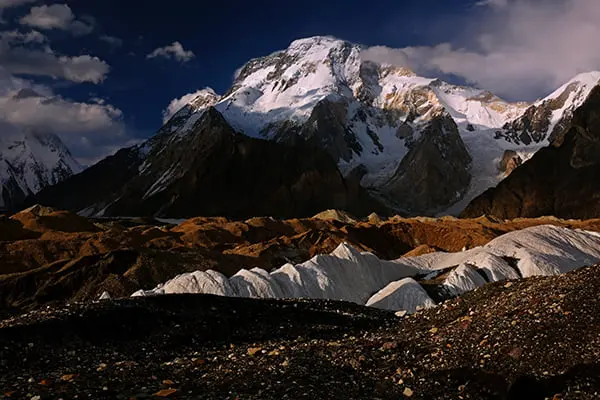
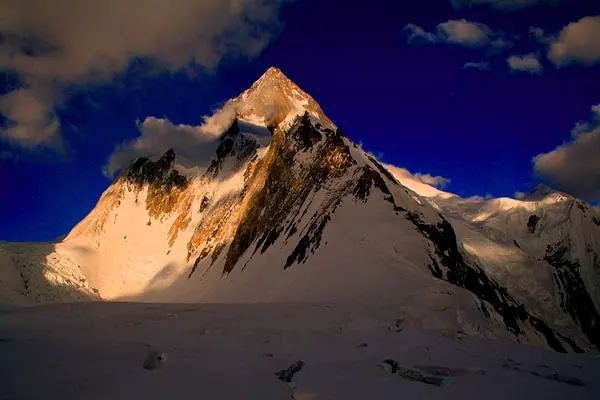
Broad Peak, Gasherbrum II and Gasherbrum I cost less than K2: $10,000 on Base Camp Only and $25,000 on Full Board, because their royalty is lower (currently USD 2,500 per person in summer). Each is a 50-day expedition with the same services as K2. To climb both Gasherbrums on one 60-day expedition, the price is $12,000 or $26,000, with both royalties included. See the Broad Peak Expedition, the Gasherbrum II Expedition, the Gasherbrum I Expedition and the Gasherbrum I and II Expedition.
All four share the K2 approach up the Baltoro Glacier as far as Concordia. If you want to see the area before committing to an expedition, the K2 Base Camp Trek follows the same route to K2 Base Camp in 21 days, and our daily distances and altitudes on the K2 trek show each stage. Our guides to the Askoli valley and places to visit in Skardu cover the start of the journey, and Before you trek in Pakistan covers the practical points of travel.
Frequently asked questions
How much does it cost to climb K2?
With Chogori Adventure, $12,000 per person on Base Camp Only or $26,000 per person on Full Board, for a 50-day expedition from Islamabad back to Islamabad in 2027. The royalty, permit, park fee and liaison officer are included. You also pay for international flights, the visa, insurance with helicopter rescue, personal gear, a summit bonus of at least USD 1,000 and tips of at least USD 300.
How much is the K2 climbing permit?
The K2 royalty is currently USD 3,500 per person in summer, the rate set by the Gilgit-Baltistan government in May 2025. It is included in both of our packages, together with the climbing permit, the national park fee and the garbage and environment fee. We apply for the permit for you; it takes several weeks, so send your documents early.
Is the K2 royalty per person or per team?
Per person. The K2 royalty of USD 3,500 in summer is charged for each climber, not for the whole team. Older group permits for seven climbers, and older figures such as USD 5,000 per person, no longer apply. Because the royalty is per person, it is the same in every private group price, while other shared costs fall as the group grows.
What is the difference between Base Camp Only and Full Board?
Base Camp Only ($12,000) covers all our services up to and at base camp, and nothing above it. Full Board ($26,000) adds one Pakistani high-altitude porter for every two climbers, a local rope-fixing team, high-camp tents, gas and stoves, food above base camp, and 2 bottles of oxygen with a mask and regulator for each climber.
How much does extra oxygen cost on K2?
USD 700 a bottle, on request, on both packages. Full Board already includes 2 bottles per climber and a mask and regulator. On Base Camp Only, oxygen is not included: you can buy bottles at USD 700 each and a mask and regulator for USD 2,000. Tell us before the expedition how many bottles you want, so we can plan the loads.
How much does an extra high-altitude porter cost?
USD 4,000 per porter, on request, on both packages. Full Board includes one Pakistani high-altitude porter for every two climbers, so an extra porter gives you one of your own. Base Camp Only has no high-altitude porters, so you add them if you need them. Nepali Sherpas or a Nepali climbing leader can also be arranged, at extra cost.
How much are the summit bonus and tips on K2?
Plan for a summit bonus of at least USD 1,000 per climber and staff tips of at least USD 300 per climber, on both packages. They are not part of the package price and are paid during the expedition. Include them in your budget from the start, together with insurance, flights, the visa and your personal gear, which are also not in either package.
Is insurance included in the price?
No. Mountaineering insurance that covers helicopter rescue and evacuation is mandatory, and you arrange it yourself. If a helicopter rescue is needed, your insurance pays for it. Global Rescue is one option, and any insurer is fine if it provides helicopter rescue and evacuation and good cover at altitude on K2 (8,611 m). We may ask for proof before departure.
Can I climb K2 outside the summer season?
Yes. The best time to climb is 20 June to 8 August, and our fixed departures start on 20 June. We run private K2 expeditions in other seasons at the same price, for example $30,000 for a solo climber on Full Board. Outside summer the weather windows are fewer and colder, so you need more experience and flexibility.
How much does the K2 Base Camp Trek cost instead?
The 21-day K2 Base Camp Trek costs $2,300 per person on a fixed departure. It follows the same route up the Baltoro Glacier to K2 Base Camp at about 5,150 m, but does not climb the mountain, so there is no royalty or climbing support. See the K2 Base Camp Trek cost guide.
How long does it take to climb K2?
About 50 days from Islamabad back to Islamabad: 4 days in Islamabad and Skardu, a 9-day approach to K2 Base Camp, rest days 13 to 15, a climbing period from day 16 to day 39, a spare day 40, and the walk out and return. The number and timing of summit days depend on the ground staff, the conditions and the weather.
Is K2 harder to climb than Everest?
Yes, K2 is widely considered more technically demanding than Everest, with a higher fatality rate and less margin for error, even though it is lower (8,611 m against 8,849 m). The climbing is steeper for longer and summit day passes the Bottleneck at about 8,200 m. You need at least one 7,000 m peak before you climb K2.
Why is K2 cheaper to climb than Everest?
We run expeditions in Pakistan only and do not quote other companies' prices. The main fixed difference is the government fee: Pakistan's K2 royalty is USD 3,500 per person in summer, much lower than Nepal's Everest permit fee. Our K2 price is $12,000 on Base Camp Only or $26,000 on Full Board, with the royalty included.
How much is the deposit, and when do I pay the balance?
You pay a 10% advance deposit to hold your place: $2,600 on Full Board or $1,200 on Base Camp Only. The balance is paid by bank transfer two weeks before you arrive, or in cash in Islamabad. Bank and currency fees are paid by the client. The summit bonus and tips are paid during the expedition.
Is the K2 deposit refundable if I cancel?
Deposits are generally non-refundable, because the permit and logistics start as soon as you book, but they can be transferred to the next two seasons. Partial refunds may apply depending on your notice and the costs already incurred. The cancellation terms are stated when you book. Read our terms and conditions before booking.
Does a private K2 expedition cost more?
It depends on the group size. On Full Board, a solo climber pays $30,000, 2 to 3 people $28,000 each, 4 to 6 people $26,000 each and 7 to 10 people $23,000 each. On Base Camp Only, the same groups pay $18,000, $14,000, $12,000 and $10,000. Larger groups share the fixed costs, so each person pays less.
Ready to climb K2?
See the dates, the full list of services and the booking form on the K2 Climbing Expedition page. Before you go, read the K2 packing list (PDF), our K2 climbing guide (route, camps and season), and everything about K2 in our K2 hub.
About the author
Riaz Ahmed Shigri is the Logistics and Marketing Manager of Chogori Adventure, with extensive experience of trekking and expeditions in the Karakoram. Chogori Adventure is a local company from Skardu, founded in 2015. We are licensed by the Department of Tourist Services (licence no. 2494) and the Gilgit-Baltistan tourism department (licence DTS-GB-055), with offices in Skardu and Islamabad. The prices on this page are our own and are checked against our K2 Climbing Expedition page.